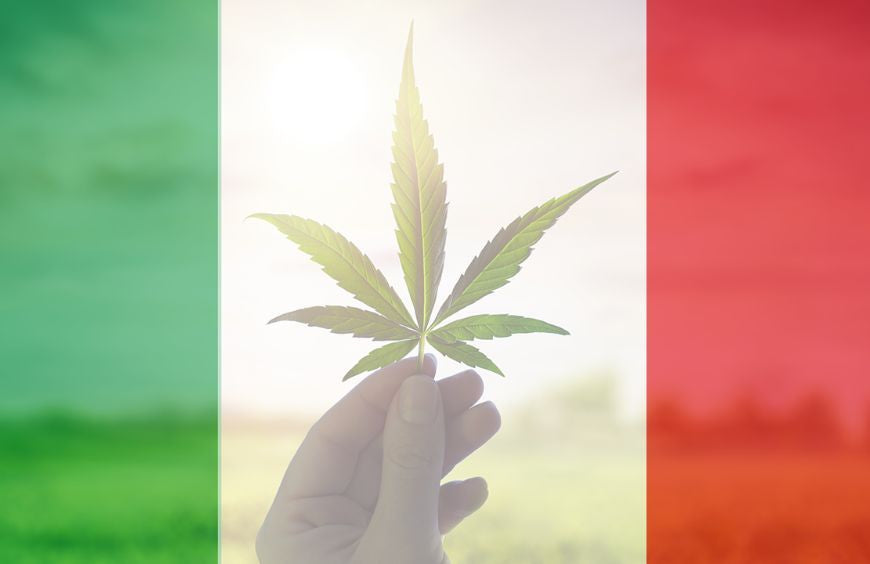
Italy faces challenges regarding CBD, despite the clarity of European legislation and the recent openness of major institutions—such as the World Health Organization and the UN—toward “light” cannabis and its derivatives. However, uncertainties still persist. This is why consumers continue to feel apprehensive about potential consequences when purchasing products containing THC and CBD. Nevertheless, since 2017, legal cannabis has entered the Italian market. More and more people are incorporating CBD-based products into their daily lives. As a result, this market is experiencing significant growth, offering an increasingly diverse range of products. However, the Italian government is stepping up its stance against “light” cannabis.
Italian Cannabis Legislation and Its Implications
Italian cannabis legislation has gone through several phases, ranging from prohibition to legalization. Let’s take a closer look at the following aspects: possession, use, cultivation, and distribution.
Possession and Use of Cannabis in Italy
What do Italian regulations say about the possession and/or use of cannabis? The answer varies depending on the time period in question. Before 2019, the possession and/or use of cannabis was prohibited. However, in December 2019, the Italian Parliament legalized it, going even beyond mere authorization. Unlike many other European countries, which set the maximum THC content at 0.2%, Italy exceeds this limit by legalizing “cannabis light”—that is, cannabis that may contain up to 0.5% THC. This news has certainly delighted the 20.7% of the population who use this substance. However, it is important to note that this must be limited to personal use and that the quantity must not exceed 15 grams under any circumstances.
Personal Cannabis Cultivation in Italy
What about cannabis cultivation in Italy? It follows the same trend as the previous case. The decision made in December 2019 authorizes the cultivation of cannabis plants, but it is subject to certain restrictions. First, the plants must be grown for personal use, and second, the quantity grown must remain reasonable—ideally no more than 5 plants.
Distribution and Sale of Cannabis in Italy
What about the distribution and sale of cannabis in Italy? It is permitted in tobacco shops and specialty stores, where "cannabis light" can be sold legally.
It is therefore clear, in light of the above, that the Italian population is free to enjoy the benefits of hemp compounds, particularly THC and CBD. The main industries that benefit from these compounds are cosmetics, food, and medicine.
A Reminder of CBD Legislation in Italy
CBD: Properties and Uses
CBD is a substance found in the Cannabis sativa plant that, unlike THC, has no psychoactive effects and offers numerous beneficial properties. CBD may be helpful in treating insomnia, sleep disorders, anxiety, depression, chronic pain, and even certain sexual problems. It can also be given to our dogs to relieve skin irritations, bone pain, and aggression. CBD offers many ways to use it, whether through topical application, smoking, or ingestion. Although research on the subject is still limited, it is advancing every day, and the results are very promising. However, in Italy, it remains difficult to consider CBD as a therapeutic compound, despite its complete legality.
In fact, unlike THC, CBD is not only legal in Italy but also throughout the European Union. Although its recognition as a therapeutic substance is still in the early stages, CBD is not illegal because it has no psychotropic effects, addictive potential, or dependency-inducing properties. The regulation mentioned earlier, which sets specific limits for THC, therefore appears to exclude CBD.
Differences Between CBD and THC
As we have mentioned on several occasions, it is important to understand the differences between CBD and THC. CBD and THC are two distinct compounds found in the Cannabis sativa plant. They have very different effects and are treated differently under the law.
Let’s take a closer look at the details. THC causes euphoria, impairs motor skills, heightens sensory perception, induces mental and muscular relaxation, reduces inhibitions, and alters the perception of time and space. However, it can also cause dry mouth, increase heart rate, slow reflexes, cause cognitive impairment, increase appetite, and lead to mood swings, anxiety, and depression. In contrast, CBD is said to promote muscle relaxation, reduce pain and inflammation, and lower blood pressure and intraocular pressure. As we can see, CBD appears to act primarily on the body rather than the mind, except insofar as it promotes relaxation and reduces anxiety and depression. As with any new substance introduced into the body, it is advisable to consult a doctor. Although CBD is legal and non-addictive, it may interact with other medications.
The Legality of the CB
We have established that CBD is completely legal in Italy and throughout Europe and can be consumed without restriction. It isn’t even mentioned in the law! However, when it comes to smoking, things get a little more… complicated. The Testo Unico in materia di disciplina degli stupefacenti (Presidential Decree No. 309 of October 9, 1990), in Table I, lists THC as a psychoactive substance but makes no mention of CBD or other cannabinoids. The law regulates the production and processing of legal hemp and cannabis, but not their distribution or consumption. Furthermore, legal cannabis flowers are aesthetically and practically indistinguishable from illegal cannabis flowers, although their effects are obviously very different. Consequently, smoking CBD could be considered a violation by the authorities. This creates a contradiction, given that these products are commercially available and easily accessible for purchase.
The Italian government is proposing a monopoly on "cannabis light"
The government's change in strategy
The Italian government is once again taking on "light" cannabis, but this time it is changing its strategy. After repeatedly attempting to ban it through bills and directives from the Ministry of the Interior, the Meloni government now wants to impose a monopoly system.
The measures proposed by the government
According to the Italian news agency ANSA, the Italian government has introduced an amendment to the fiscal mandate in the Finance Committee. This amendment includes several measures, notably:
- Authorization and Regulation: A system of authorization by the Customs Agency for the sale of “cannabis light” would be established.
- Prohibitions: The ban on online sales, sales to minors, and advertising, as well as the ban on smoking in enclosed spaces, would be enforced.
- Taxation: "Light" cannabis would be subject to the same taxation as cigarettes. A tax system would be established for the cultivated parts of hemp intended for use in products meant to be smoked or inhaled.
- Monopoly Sales: Sales would be primarily restricted to monopoly retailers or specialized retail outlets holding a monopoly sales license.
- Strict controls: Marketing and sales would be permitted only through authorized tax warehouses, with special safeguards in place for warehouses authorized to manufacture.
- Warning labels: Warning labels about the risks of cannabis use are also reportedly being considered.
Reactions and Concerns
The Italian cannabis media outlet DolceVita acknowledges the need for appropriate regulation but expresses concerns about the government’s proposal. It regrets that existing stores selling “cannabis light” are excluded from the proposal and emphasizes that high taxation risks harming the sector. Furthermore, the outlet raises a fundamental issue: the sector has faced years of lawsuits, with legal businesses labeled as drug traffickers. According to the outlet, it is necessary to acknowledge the mistakes made so far by politicians and to rectify the situation.
Conclusion
In summary, the situation regarding CBD in Italy is complex and constantly evolving. Despite the clarity of European legislation and the supportive stances of certain international institutions, Italy continues to face persistent doubts and prejudices regarding “light” cannabis and its derivatives. The lack of specific regulations and negative associations with organized crime contribute to maintaining a certain level of mistrust among consumers.
However, since its legalization in 2017, the Italian market for CBD products and legal cannabis has experienced exponential growth. CBD products have gained popularity in many people’s daily lives, offering a variety of forms and uses, ranging from candies to personal lubricants. Despite this market expansion and growing acceptance among part of the population, challenges remain in terms of regulation and public perception.
Italian cannabis legislation has evolved from prohibition to legalization, but some questions remain. Regulations have been put in place governing possession, use, cultivation, and distribution, but restrictions and ambiguities persist. Understanding the differences between CBD and THC is also crucial, as this affects the regulation and perception of cannabis-derived products.
The Italian government is seeking to establish a monopoly on light cannabis, with strict measures governing its marketing, sale, and distribution. This approach has sparked mixed reactions, with some emphasizing the need for adequate regulation, while others fear the impact on the emerging light cannabis industry.
Overall, the issue of CBD in Italy remains complex and constantly evolving. Striking a balance between regulations that ensure consumer safety and the recognition of CBD’s potential benefits in various fields—such as health, cosmetics, and food—is essential. An approach based on solid scientific data and a clear understanding of the differences between CBD and THC will be necessary to guide future legislation and policies regarding “light cannabis” in Italy.