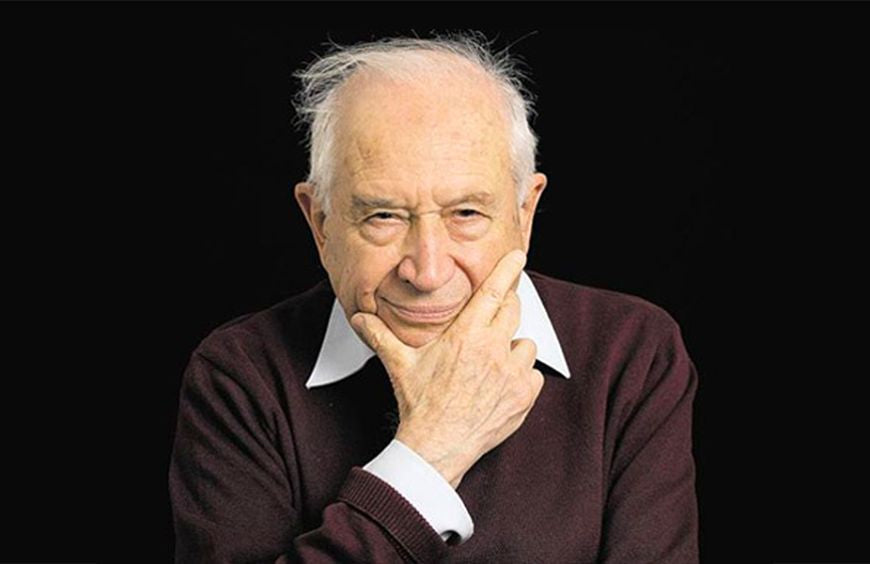
For the past few days, consumers of cannabis and cannabis-derived products around the world have been paying tribute to a man whose contribution to the discovery of cannabis’s active compounds changed the history of this ancient plant. Dr. Raphael Mechoulam, a chemist and scientist, passed away at the age of 92 in Israel, leaving behind an invaluable scientific legacy.
Among Raphael Mechoulam's achievements, one can notably mention his contribution to the isolation of delta-9 tetrahydrocannabinol (THC), the primary psychoactive compound in cannabis. But the chemist is also credited with the discovery of cannabidiol (CBD), a non-psychotropic molecule with promising therapeutic properties.
A professor at the School of Pharmacy at the Hebrew University of Jerusalem, Raphael Mechoulam devoted more than forty years of his life to the study of the cannabis plant and its medical use. A small man with a cheerful voice, he became a leading advocate for the international cannabis movement, sharing his knowledge with the entire world. In this article, we’ll take a look at Raphael Mechoulam’s contributions to cannabis science, as well as his impact on the industry and current research.
Who was Raphael Mechoulam, and what was his role in the history of CBD?
Raphael Mechoulam was an Israeli chemist and scientist who played a crucial role in the history of cannabis research. Born in 1930 in Sofia, Bulgaria, he grew up in Israel and earned his Ph.D. in organic chemistry from the Hebrew University of Jerusalem in 1958.
In the 1960s, while he was a professor at the university's School of Pharmacy, Raphael Mechoulam began to take an interest in the cannabis plant and its active compounds. In 1963, he became the first scientist to isolate delta-9 tetrahydrocannabinol (THC), the plant's main psychoactive compound.
However, it wasn't just the discovery of THC that made Raphael Mechoulam a key figure in the history of cannabis. In fact, he is also known for isolating and identifying cannabidiol (CBD) in 1963, a non-psychoactive compound found in cannabis.
His research has led to a better understanding of the pharmacological effects of THC and CBD on the human body, paving the way for numerous studies on the potential medical uses of these compounds.
Raphael Mechoulam thus played a key role in the scientific recognition of cannabis as a medicinal plant, thereby contributing to the emergence of a market for medical and recreational cannabis. His discovery of CBD, in particular, has sparked great interest in the field of medical research due to its anti-inflammatory, analgesic, and antiepileptic properties, among others.
The Discovery of CBD: How Did Raphael Mechoulam Demonstrate the Properties of This Molecule?
As mentioned earlier, Raphael Mechoulam is known for isolating and identifying cannabidiol (CBD) in 1963. This discovery was made in collaboration with Yechiel Gaoni, another researcher at the Hebrew University of Jerusalem.
To isolate CBD, Mechoulam and Gaoni used a technique called reverse-phase chromatography, which separates the components of a mixture based on their interactions with a column packed with a specific substance. They then used mass spectrometry to identify the isolated components.
The discovery of CBD was significant because it showed that this molecule, unlike THC, has no psychoactive effects. This discovery led to a better understanding of the effects of cannabis on the human body and paved the way for numerous studies on the potential medical uses of CBD.
Raphael Mechoulam went on to conduct several studies on the pharmacological effects of CBD, particularly its anti-inflammatory, analgesic, and antiepileptic properties. In the 1980s, he discovered that CBD could be used to treat epilepsy in children, which sparked significant interest in this compound within the medical community.
More recently, Raphael Mechoulam's research has shown that CBD can also be used to relieve the symptoms of conditions such as anxiety, depression, chronic pain, and even cancer.
In summary, Raphael Mechoulam’s discovery of CBD was a major milestone in the scientific recognition of cannabis as a medicinal plant. His research on this molecule paved the way for numerous studies on the potential medical uses of cannabis and contributed to the emergence of a market for CBD for both medical and recreational use.
Medical Applications of CBD: Has Raphael Mechoulam’s Research Opened Up New Therapeutic Possibilities?
Raphael Mechoulam's research on the medical applications of CBD has been very promising and has generated significant interest in the medical community. Here are some of the most important findings from his research:
CBD in the Treatment of Epilepsy
One of the most interesting medical applications of CBD is its use in the treatment of epilepsy. In 1980, Raphael Mechoulam conducted a study that showed CBD could reduce seizures in children with epilepsy. Since then, numerous studies have been conducted on the use of CBD in the treatment of epilepsy, and the results have been very encouraging.
CBD in Reducing Anxiety and Depression
CBD has also been studied for its potential to reduce anxiety and depression. Studies have shown that CBD may help reduce anxiety symptoms in patients with anxiety disorders such as panic disorder, obsessive-compulsive disorder, and post-traumatic stress disorder. Similarly, studies have shown that CBD may help reduce symptoms of depression in patients with depression.
CBD for the Relief of Chronic Pain
CBD has also been studied for its potential to relieve chronic pain. Studies have shown that CBD may indeed help reduce pain in patients with chronic conditions such as neuropathic pain, arthritis-related pain, and cancer-related pain.
CBD in the Relief of Cancer Symptoms
Finally, CBD has also been studied for its potential to relieve cancer symptoms. Although research on CBD and cancer is still ongoing, studies have shown that CBD may help reduce the growth of cancer cells in laboratory animals.
The Impact of Raphael Mechoulam's Research on the Cannabis Industry: How Has the Discovery of CBD Influenced the Market for Cannabis-Based Products?
The discovery of CBD has had a significant impact on the cannabis industry and has opened up new possibilities for cannabis-based products. Here are a few points about the impact of Raphael Mechoulam’s research on the cannabis industry:
CBD-derived products
The discovery of CBD has led to an explosion of CBD-based products on the market. These products can be used to relieve pain, anxiety, inflammation, and other conditions. CBD-based products are now commonly found in health food stores, pharmacies, specialty shops, and even supermarkets.
CBD Regulations
The discovery of CBD has also had an impact on cannabis regulations. In many countries, CBD is legal, while THC is not. This has opened up new markets for cannabis-based products. However, CBD regulations are complex and vary from country to country. Furthermore, the cannabis industry remains heavily regulated and restricted, which can complicate the production and distribution of cannabis-based products.
The Future Outlook for the Cannabis Industry
The discovery of CBD has also opened up new possibilities for the cannabis industry. Raphael Mechoulam’s research has shown that cannabis has considerable therapeutic potential. Future research could therefore lead to new medical applications for cannabis, as well as new cannabis-based products. For example, research is currently underway on the use of cannabis to treat conditions such as multiple sclerosis, cancer, and epilepsy.
In conclusion, Raphael Mechoulam’s discovery of CBD has had a significant impact on the cannabis industry. It has led to an explosion of CBD-based products on the market, influenced cannabis regulations, and opened up new opportunities for the cannabis industry in the field of medical treatments.
Raphael Mechoulam, a dedicated researcher to the very end
Raphael Mechoulam was a passionate researcher who dedicated his life to research on medical cannabis. Even in his later years, he continued to innovate and develop new therapies to help patients suffering from various illnesses. At the CannMed cannabis conference in California in 2019, Mechoulam announced the creation of a new, synthetically stable cannabidiolic acid (CBDA) suitable for clinical use.
By synthesizing the unstable acid molecules found in the cannabis plant, Mechoulam created a stable and consistent foundation for research into new therapies for a wide range of medical needs. This paves the way for new therapeutic possibilities for patients suffering from various conditions, such as epilepsy.
However, Mechoulam was also aware of the research time that had already been lost and of the patients who had been unable to benefit from cannabis-based treatments for their illnesses. He urged the scientific community to provide greater support for medical cannabis research and lamented the fact that thousands of children had not been able to receive timely help.
In 2000, Mechoulam received the Israeli Prize in the Exact Sciences—Chemistry—for his contributions to science, and in 2011, he received the NIDA Discovery Award. In 2019, he was awarded the Harvey Prize for his breakthroughs in the field of science and technology.
Mechoulam's discovery of synthetically stable cannabidiolic acid is a major breakthrough in medical cannabis research and demonstrates his commitment to discovering new therapies to help patients in need.