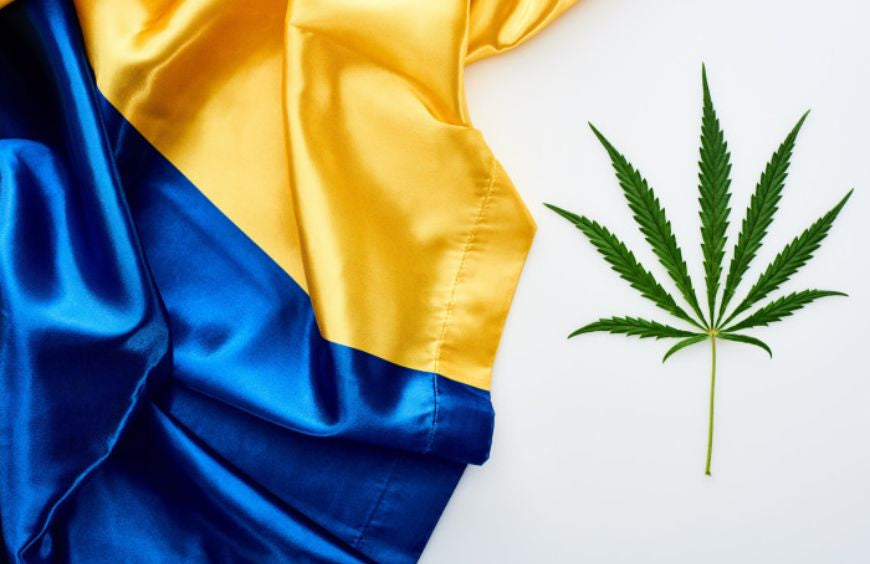
Ukrainian President Volodymyr Zelensky has called for the legalization of medical cannabis to help Ukrainians overcome the trauma of the war with Russia.
In fact, on June 28, President Zelenskyy stated in a speech to the Ukrainian parliament: “All the world’s best practices, all the most effective policies, and all solutions—no matter how difficult or unusual they may be for us—must be implemented in Ukraine so that Ukrainians, all our citizens, do not have to endure the pain, stress, and trauma of war. In particular, we must finally legalize cannabis-based medications for all those who need them, based on appropriate scientific research and controlled Ukrainian production.”
We'll cover more information on this topic in this article, but first we'll take a closer look at what medical cannabis is.
A Reminder About Medical Cannabis
Medical cannabis is widely discussed and debated among scientists, doctors, and politicians on the international stage. More and more countries are legalizing it, studies are highlighting its benefits, and much more. But what exactly is medical cannabis? How is it different from recreational cannabis?
What is medical cannabis?
Medical cannabis, also known as therapeutic cannabis, refers to the use of cannabis by an individual to treat or alleviate a specific symptom or condition. As a result, cannabis is no longer sought after solely for its psychoactive effects, but for its potential healing properties.
The key to how cannabis affects the human body lies in cannabinoids, the active ingredients in cannabis. There are currently fewer than 100 known cannabinoids. The two cannabinoids that have been most extensively studied and are most commonly used for their therapeutic properties are CBD (cannabidiol) and THC (tetrahydrocannabinol).
Medical cannabis can be administered in various forms, ranging from well-known pharmacy tablets to dried flowers.
Currently, medical cannabis is not legal in France. A two-year pilot program, launched in 2020, allowed 3,000 patients to receive medical cannabis, confirmed its potential benefits, and made it available to all patients who could benefit from it.
What is the status of medical cannabis around the world?
Cannabis has been used for thousands of years to treat a wide range of ailments. The earliest known instances of cannabis’s medical use date back to 2700 B.C. It is described in Emperor Shennong’s *Encyclopedia of Aromatic Herbs*, one of the oldest texts on herbal medicine. Cannabis was then used for centuries until it was banned in the early 19th century. Cannabis was most often consumed in solid form or as a beverage.
But since the 1960s, scientists have resumed their study of cannabis. In 1963, Raphaël Mechoulam and his team succeeded in isolating THC, then CBD, and finally the endocannabinoid system.
In 1996, California became the first state in the United States to legalize medical cannabis. Over the years, the potential benefits of cannabis have come to the fore again, and the legalization of cannabis has spread around the world. The Netherlands decriminalized cannabis in the 1970s, and Portugal followed suit in 2000. In 2013, Uruguay became the first country in the world to legalize cannabis. Cannabis is now decriminalized in Austria, Belgium, Canada, Chile, Colombia, Spain, Finland, Israel, the Netherlands, the Czech Republic, and even the United Kingdom, all of which offer some form of medical access to cannabis. In the United States, cannabis remains illegal at the federal level, but medical cannabis is legal in 29 states.
How does medical cannabis relieve pain?
Medical cannabis is believed to be effective in treating a wide range of medical conditions and ailments due to its potential effects on the endocannabinoid system. It has, in fact, proven effective in treating and alleviating numerous conditions, such as:
- glaucoma,
- Parkinson's disease,
- asthma,
- multiple sclerosis,
- epilepsy,
- Crohn's disease,
- diabetes,
- Tourette syndrome,
- cancer
- and post-traumatic stress disorder.
The same applies to pathological syndromes such as:
- anxiety,
- paranoia,
- nausea,
- depression,
- and menstrual cramps.
To be clear, cannabis rarely cures diseases. It very often treats the symptoms of illness with fewer side effects than traditional medications. Cannabis is also effective when other medications do not work. It is particularly effective for pain and epilepsy in children. It can also be expected to be effective for diseases affecting the elderly, such as Alzheimer’s disease and Parkinson’s disease.
The potential medicinal benefits of cannabis depend on the dose, the cannabinoid composition of the strain and the medication, and the route of administration. Some medications, such as Sativex—which is available in France to treat spasticity associated with multiple sclerosis—require phytocannabinoids (CBD and THC) to be administered via an oral spray. Medical cannabis can also be ingested (for non-smokers), vaporized, or smoked (as a last resort). Patients can also consume cannabis in less familiar ways, such as patches or suppositories.
Some varieties of medical cannabis
It’s important to note that any type of cannabis can be medicinal, as long as it alleviates the patient’s symptoms. Some cannabis strains have more medicinal properties than others. Among them are strains with high CBD content, such as:
- Charlotte’s Web: This strain has no psychoactive effects. It was developed to treat Charlotte Figi, a girl with epilepsy who suffers from Dravet syndrome. For medical use, it is typically consumed in high doses in the form of oil.
- The Harlequin strain: It has a high CBD content. With a strong Sativa dominance, it is said to be effective against pain, anxiety, and paranoia caused by THC. It may therefore help patients with Parkinson’s disease or multiple sclerosis.
The medical use of cannabis is often stigmatized and even demonized, especially since the line between medical and recreational cannabis can sometimes be blurred.
What should you know about this upcoming reform to legalize medical cannabis in Ukraine?
Ukrainian President Volodymyr Zelenskyy brought the issue back to the table in a recent speech following his first defeat in parliament last year.
Zelensky had stated that he supported this even before becoming president. On April 18, 2019, Volodymyr Zelensky expressed his desire to legalize medical cannabis in Ukraine while speaking at the Royal Bank of Canada. A few years later, in June 2022, while the war in Russia was already in full swing, certain factions within the government approved a similar bill. All that’s left is parliamentary approval, which requires the support of at least 226 members of parliament. The problem is that the vote a few months later failed to reach the required number of votes.
A few days ago, the Ukrainian president brought the issue back to the table during a speech to parliament. As part of the process of developing his plans for the future, numerous measures were proposed as a token of gratitude to all those who fought for Ukraine’s freedom and independence. One of the announcements was a guarantee that members of the Ukrainian armed forces would still be able to find work in the civil service after the war if they so desired. Those wishing to return to civilian life will be entitled to relevant civilian professions so that veterans can fully integrate into the nation’s social and economic life. In addition to announcing the imminent implementation of new requirements regarding urban planning, infrastructure, public spaces, transportation, social and educational systems, and the business environment, this will enable all those traumatized by the war to enjoy the same space and the same quality of life. They will thus have the same opportunities as everyone else. Psychological factors were also addressed.
“Ukraine must create the strongest rehabilitation industry in Europe. This applies both to the construction of rehabilitation centers and to the training of those involved,” said Volodymyr Zelenskyy, adding that all the best practices from around the world, all the policies that work best, and all the solutions—no matter how difficult or unusual they may seem to us—must be implemented; and above all, we must finally legalize cannabis for all those who need it.”
It is difficult to say whether Ukraine will finally approve the legalization of medical cannabis, after rejecting it for the first time last year. What is certain is that the country’s president is determined to do everything in his power to achieve this goal. Furthermore, Health Minister Viktor Lyashko intends to support him in this effort.
Last year, before Parliament rejected the measure, Volodymyr Zelenskyy stated that members of his cabinet understood the negative impact of the war on mental health. Furthermore, many people are reportedly in need of treatment due to this negative impact. This treatment could take the form of medical cannabis.